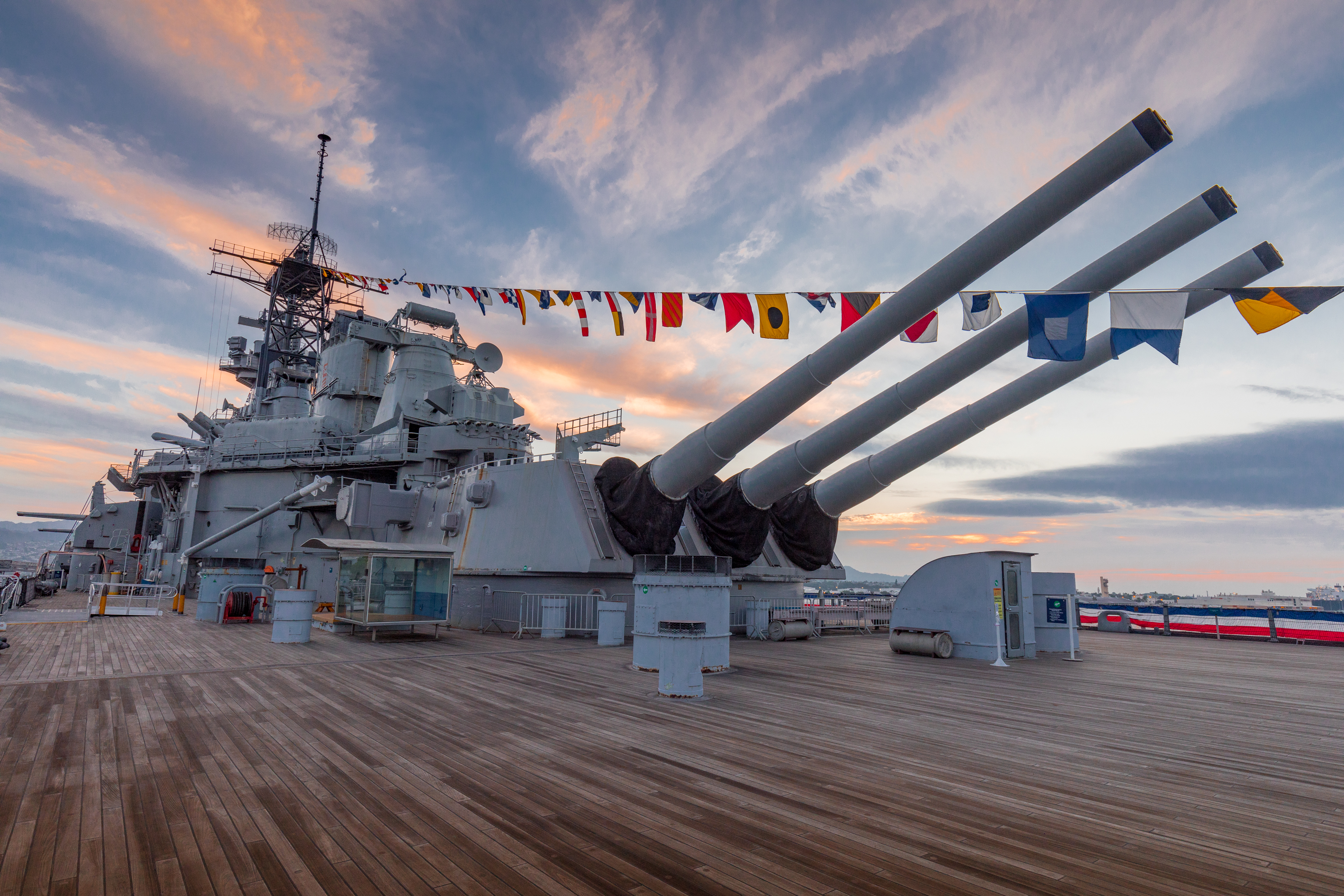
Step aboard the mighty USS Alabama, a WWII-era battleship turned living monument to naval power. From her combat legacy in the Pacific to towering 16-inch guns, this South Dakota-class battleship is a must-see for history buffs and patriots alike. Discover a warship that once ruled the seas.
- Home
- •
- Events
- •
- Places
- •
- Community
- •
- Classifieds
Battleship Museums
Battleships preserved as museums and memorials, from the USS Missouri and the USS Arizona Memorial to the USS Iowa, the USS New Jersey, the USS North Carolina and the USS Massachusetts. Hawaii has more than any other state.
The USS Iowa is a floating piece of history you don’t want to miss. Known as the "Battleship of Presidents," it served in World War II, the Korean War, and the Cold War. This massive ship even carried President Franklin D. Roosevelt during wartime, earning its place in the history books.
Visitors can walk its decks, see its huge 16-inch guns, and explore crew areas to learn what life was like aboard this powerful battleship. With interactive exhibits and incredible views, the USS Iowa offers a hands-on experience for history lovers of all ages.
Moored on the Camden waterfront, USS New Jersey (BB-62) presents an intact cross-section of U.S. naval power from the mid-20th century through the Cold War. As an Iowa-class fast battleship, her hull and machinery embody the late apex of battleship design: a long, lean form built for high speed, heavy armor, and sustained operations alongside carrier task forces. The three 16-inch/50 caliber Mark 7 turrets and extensive 5-inch secondary battery illustrate how one platform was engineered to deliver both long-range shore bombardment and dense anti-aircraft fire. New Jersey’s combat record, with service in World War II, Korea, Vietnam, and the 1980s Lebanon operations, gives the ship unusual chronological depth; the layering of modifications, from removed light anti-aircraft guns to added Tomahawk and Harpoon launchers and Phalanx CIWS, shows how a World War II battleship was repeatedly adapted to new doctrines. Preserved as a museum since 2001, she allows close study of original teak decking, compartmentalization, and fire-control arrangements, all maintained against the corrosion and structural stresses imposed by decades in saltwater and now by long-term static display.
Moored along the Norfolk waterfront, USS Wisconsin (BB-64) presents the architecture of American sea power at full scale. This Iowa-class fast battleship, completed in 1944, embodies the late evolution of the battleship concept: long, lean hull; heavy armor; and a machinery plant designed for speeds exceeding 30 knots. Her service record threads through three distinct conflicts. In the Pacific during the Second World War, Wisconsin supported major operations including the Philippines campaign and the battles of Iwo Jima and Okinawa, later turning her guns on targets in the Japanese home islands in 1945. Recalled for the Korean War, she reverted to her original role as a gun platform for shore bombardment in support of United Nations forces. Modernized in the 1980s with contemporary combat systems, she fired again in anger during Operation Desert Storm, earning a Navy Unit Commendation. Now preserved as a museum ship beside Nauticus, Wisconsin offers a rare opportunity to study how one hull was adapted across eras—from analog fire control to missile-age warfare—while confronting the practical challenges of maintaining a 1940s capital ship in a modern urban harbor.
Moored in the Taunton River at Fall River, USS Massachusetts (BB-59) presents a compact study in treaty-era battleship design and late–World War II modifications. As a South Dakota–class fast battleship, she embodies the engineering compromises forced by the 35,000-ton limit while mounting 16-inch guns and armor intended to resist weapons of the same caliber. The resulting dense arrangement of machinery, magazines, and crew spaces is still legible in her preserved configuration. Her wartime record gives the steel context: opening her combat career in Operation Torch in 1942, she dueled with the unfinished French battleship Jean Bart off North Africa before shifting to the Pacific. There she spent most of the war screening fast carrier task forces, participating in the Gilberts and Marshalls operations, the Philippines campaign, the Battle of Okinawa, and later bombardments of industrial targets on Honshu. Saved from scrapping and transferred in 1965 to the Massachusetts Memorial Committee, Massachusetts now survives at Battleship Cove with much of her World War II appearance intact, illustrating both the peak of American battleship construction and the preservation challenges of a heavily armed, densely built capital ship.
Moored on the Cape Fear River, USS North Carolina (BB-55) presents one of the most intact examples of an American fast battleship of the Second World War. As the lead ship of the North Carolina class and the first U.S. battleship built under the Washington and Second London Naval Treaty constraints, she embodies the engineering compromises and innovations of interwar naval architecture: a 35,000-ton treaty hull carrying nine 16-inch guns, powerful turbines rated at 121,000 shaft horsepower, and a carefully balanced scheme of armor, speed, and endurance. Wartime service in the Pacific—from screening carriers off Guadalcanal and engaging at the Battle of the Eastern Solomons, to supporting operations in the Gilberts, Marshalls, Marianas, and later Iwo Jima and Okinawa—left operational imprints still legible in her layout and equipment. Decommissioned soon after the war and narrowly rescued from scrapping in 1960, the ship now stands as a large-scale preservation effort in steel, illustrating both the logistical challenge of maintaining a capital ship in peacetime and the enduring interest in the battleship era within American naval history.
The USS Utah (BB-31) Memorial occupies a quieter edge of Pearl Harbor, where the remains of the Florida-class dreadnought lie just offshore. Commissioned in 1911, Utah represented an early generation of American all-big-gun battleships, with ten 12-inch main guns and Parsons turbines driving four shafts—hardware that marked the U.S. Navy’s transition into the dreadnought era. Her later conversion under the London Naval Treaty into target ship AG-16, fitted with a variety of anti-aircraft weapons, turned the hull into a full-scale laboratory for gunnery and aviation training. The memorial interprets that layered career alongside the ship’s final moments on 7 December 1941, when torpedoes struck, she capsized rapidly, and dozens of crewmen were lost. Unlike the more prominent Arizona, Utah remains partially visible and largely undisturbed, emphasizing issues of underwater corrosion, structural collapse, and the ethics of managing a war grave within an active naval base. For naval historians, the site frames the entire life cycle of a capital ship—from prestige fleet asset to experimental platform to enduring relic of the opening blows at Pearl Harbor.
Historic Battleships Preserved as Museums and Memorials
Battleships are some of the most powerful ships ever built. Known for their massive size and heavy firepower, they played important roles in major wars and symbolized military strength.
Today, a few of the most noteworthy battleships have been turned into museums across the United States. These floating museums let visitors explore their incredible history and learn about the sailors who served aboard them.
You can walk the decks, see the giant guns, and visit the crew’s living spaces. Some museums even have interactive exhibits and guided tours to make the experience even more exciting. If you are lucky, you might even find a battleship parked next to a Submarine!
From World War I ships like the USS Texas to the Cold War-era USS Iowa, these museums are perfect for all ages. They bring history to life and inspire curiosity about the past.
If you love history or want to see these massive warships up close, battleship museums are a must-see!
What to Expect When Touring a Battleship
Touring a battleship is a one-of-a-kind experience, but it’s important to know what to expect. These massive warships were built for combat, not comfort, so exploring one can feel like an adventure!
Be prepared to navigate narrow passageways, climb steep ladders, and step over high thresholds between rooms. Watch out for overhead obstacles, like pipes and low ceilings, especially in the crew areas. Comfortable shoes are a must since there’s a lot of walking and sometimes climbing involved.
Battleship tours are great for all ages, but younger children and those with mobility challenges may need extra help navigating certain areas. Most museums also offer special accommodations, so be sure to check with staff if needed.
Taking a tour of a battleship gives you a real sense of what life was like for sailors. It’s an unforgettable, hands-on way to connect with history—just be ready for the adventure!
Reach Serious Military Vehicle Collectors
Every buyer here already knows what they’re looking at. No explaining, no haggling with the wrong crowd. Just connect with enthusiasts who understand the value of what you’re selling.
0 in this view
Each marker is a button. Use the results list for the same places and events in order.
Scroll for more, or pan the map