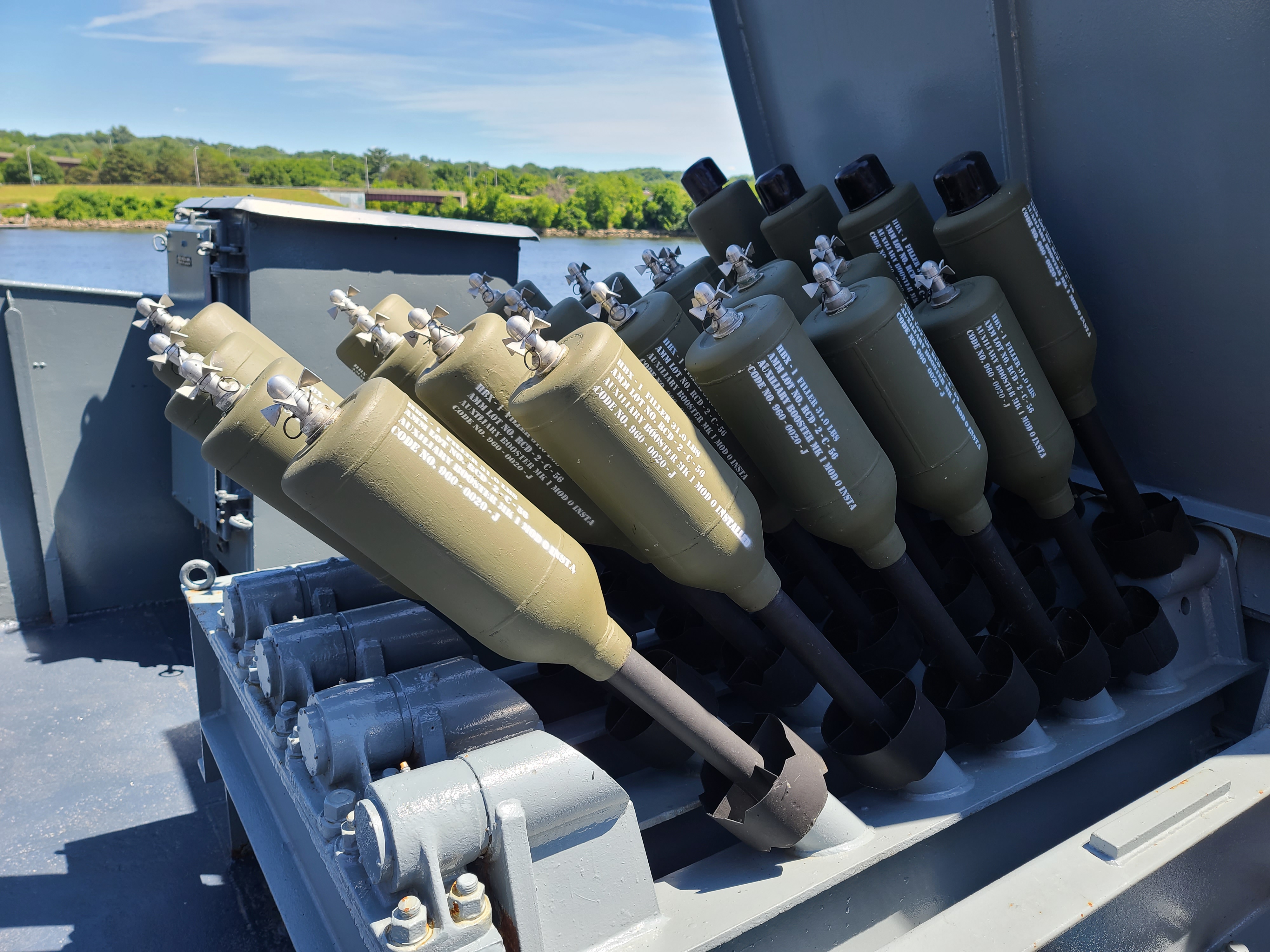
USS Slater (DE-766) lies moored on the Hudson River in Albany as a rare survivor of a vast but largely vanished warship class. This Cannon-class destroyer escort, commissioned in 1944 and built at Tampa Shipbuilding Company, represents the compact end of mid-20th-century naval engineering: optimized for convoy duty, anti-submarine work, and long days on the North Atlantic. During the Second World War she escorted multiple convoys to the United Kingdom and briefly operated in the Pacific, giving the ship a service pattern typical of her type without the embellishment of major battle fame. Postwar, she served four more decades in the Hellenic Navy as Aetos, part of the “Wild Beasts” flotilla, before returning to the United States as a museum ship. Enthusiasts encounter the only destroyer escort afloat in the U.S. preserved in wartime configuration, designated a National Historic Landmark in 2012. The steel, fittings, and compartment layout reveal how small-ship crews lived and fought in the Battle of the Atlantic era, while the very survival of the vessel underscores the preservation challenges of keeping a working-class warship intact on a northern riverfront.
- Home
- •
- Events
- •
- Places
- •
- Community
- •
- Classifieds
Destroyer Museums
Destroyers and destroyer escorts you can tour, from the USS Kidd and the USS Laffey to the USS The Sullivans, the USS Cassin Young, the USS Turner Joy and the USS Slater.
Moored along Buffalo’s inner harbor, USS The Sullivans (DD-537) represents both front-line destroyer design of the Second World War and one of the most personal memorials in the U.S. Navy. This Fletcher-class destroyer carries the name of the five Sullivan brothers, all lost when USS Juneau was torpedoed off Guadalcanal in 1942, a tragedy that reshaped public awareness of wartime sacrifice and led to the rare decision to name a ship for multiple individuals. Commissioned in 1943, The Sullivans operated in the Pacific, screening fast carriers during major raids and providing the sort of anti-air and anti-submarine protection that made the carrier task force viable as an offensive instrument. Later service in the Korean War and with the 6th Fleet extended her career into the early Cold War, illustrating how wartime hulls were adapted to new strategic realities. Preserved within the Buffalo and Erie County Naval & Military Park alongside USS Little Rock and USS Croaker, the ship now poses ongoing preservation challenges typical of aging steel warships, underscored by the 2022 hull breach and partial sinking that highlighted the technical and financial demands of keeping a mid-century destroyer intact as a tangible primary source.
Moored on the Bremerton waterfront near the shipyard that completed her, USS Turner Joy (DD-951) presents a Forrest Sherman–class destroyer preserved close to her point of origin. Commissioned in 1959 and serving exclusively in the Pacific, the ship represents the post–Korean War transition in U.S. destroyer design, bridging World War II–era gun destroyers and the missile age. Her Vietnam War record, including her role as one of the principal U.S. Navy units in the Gulf of Tonkin incident, anchors the vessel in the critical early phase of American escalation. The preserved hull and superstructure make it possible to study Cold War surface combatant layout, with its emphasis on gunfire support, antisubmarine warfare tasks, and flag accommodations for destroyer squadron command. Interpreted today as a museum ship, Turner Joy offers a rare opportunity to examine how a frontline combatant was built, modernized, and ultimately retired as naval technology moved toward more automated, missile-centered platforms, while also serving as a material reminder of the decisions and events that drew the United States deeper into conflict in Southeast Asia.
Moored in the Charlestown Navy Yard opposite USS Constitution, USS Cassin Young (DD-793) presents a rare surviving example of a Fletcher-class destroyer preserved in largely authentic configuration. Launched in 1943 and commissioned at the end of that year, the ship represents the mass-produced, hard-worked surface combatants that underpinned U.S. naval operations in the Pacific. Cassin Young joined the Fast Carrier Task Force and screened carriers through major 1944–45 operations, including strikes connected to Saipan, Tinian, Guam, and the wider campaigns culminating in Leyte Gulf and Okinawa. Later reactivated during the Korean War era and in commission until 1960, the destroyer’s long career charts the transition from World War II to Cold War fleet requirements. Designated a National Historic Landmark in 1986 and one of only a handful of Fletcher-class ships still afloat, it now functions as a museum vessel within Boston National Historical Park. The setting within an historic navy yard underscores the ship’s significance as an artifact of industrial shipbuilding, radar-directed gunnery, and late-war anti-air and picket tactics rather than a static monument.
Moored along the Saginaw River in Bay City, USS Edson (DD-946) presents one of the few remaining opportunities to examine a Forrest Sherman–class destroyer in three dimensions rather than on the page. Built at Bath Iron Works and commissioned in 1958, Edson represents the first generation of post–World War II American destroyer design, bridging wartime experience with Cold War requirements. Her steel, compartmentalization, and weapons foundations speak to an era of blue-water operations in the Western Pacific, from Taiwan Strait patrols to intensive Vietnam War duty. The ship’s record includes multiple deployments to the Gulf of Tonkin, Navy Unit Commendations for meritorious service there, and later roles in the evacuations of Phnom Penh and Saigon, giving the hull a direct link to pivotal late–20th century conflicts. Now a National Historic Landmark and one of only two surviving Forrest Sherman destroyers, Edson also anchors the Saginaw Valley Naval Ship Museum, turning a riverside industrial setting into a reference point for Cold War naval engineering, crew life, and the preservation challenges of maintaining a large steel combatant outside salt water.
Moored among the collection at Battleship Cove in Fall River, USS Joseph P. Kennedy Jr. (DD-850) presents one of the few surviving examples of a Gearing-class destroyer in preserved condition. Commissioned in December 1945 and built at Bethlehem Steel’s Fore River Shipyard, the ship reflects the late–World War II evolution of American destroyer design, where range, seakeeping, and anti-submarine capability were pushed to new levels. Its configuration, altered over decades of modernization, illustrates how Cold War requirements reshaped a wartime hull for new missions, from carrier screening to space program recovery work. The vessel’s record—ranging from Korean War operations to participation in the Cuban Missile Crisis quarantine and service with Gemini 6 and 7 recovery forces—gives the steelwork and compartments clear historical anchors without romanticism. As a National Historic Landmark and one of a small number of Gearing-class destroyers left, it serves as a reference point for studying postwar U.S. naval doctrine, crew life on a high-tempo Atlantic Fleet destroyer, and the preservation challenges of maintaining a complex, aging combatant in a coastal New England environment.
Moored along the St. Johns River in downtown Jacksonville, USS Orleck (DD-886) presents a concentrated study in late–World War II and Cold War destroyer design. As a Gearing-class destroyer commissioned in September 1945, she represents the zenith of wartime U.S. destroyer engineering, later reshaped by a FRAM I modernization in 1962 that illustrates how hulls from the 1940s were adapted for anti-submarine warfare in the missile age. Her long U.S. Navy career, including service with the Seventh Fleet in the Korean War and extensive operations off Vietnam—from plane guard duties on Yankee Station to naval gunfire support and participation in Operation Sea Dragon—gives the ship particular value as a platform for studying evolving naval tactics, electronics, and weapons fit from the 1940s through the 1970s. Subsequent transfer to the Turkish Navy as TCG Yücetepe (D 345) adds a NATO alliance dimension, showing how American-built destroyers were redistributed and kept operational abroad. Now berthed as a museum ship, USS Orleck serves as a preserved artifact from three major conflicts and multiple navies, anchored in an urban waterfront setting that underscores her transition from front-line combatant to historical reference point.
Historic Naval Destroyers Preserved as Museums
This collection includes destroyers preserved from multiple periods, with many dating to World War II and the early Cold War era. Visitors can typically tour decks, bridge areas, gun mounts, engineering spaces, and crew quarters while learning about missions such as convoy escort, anti-submarine warfare, and fleet defense.
As museum ships, destroyers help illustrate the scale and intensity of naval service aboard smaller combatants. Preserving these vessels allows visitors to better understand the technology, tactics, and daily realities faced by sailors serving on the front lines of maritime warfare.
Reach Serious Military Vehicle Collectors
Every buyer here already knows what they’re looking at. No explaining, no haggling with the wrong crowd. Just connect with enthusiasts who understand the value of what you’re selling.
0 in this view
Each marker is a button. Use the results list for the same places and events in order.
Scroll for more, or pan the map